 BY BRIAN CROSS
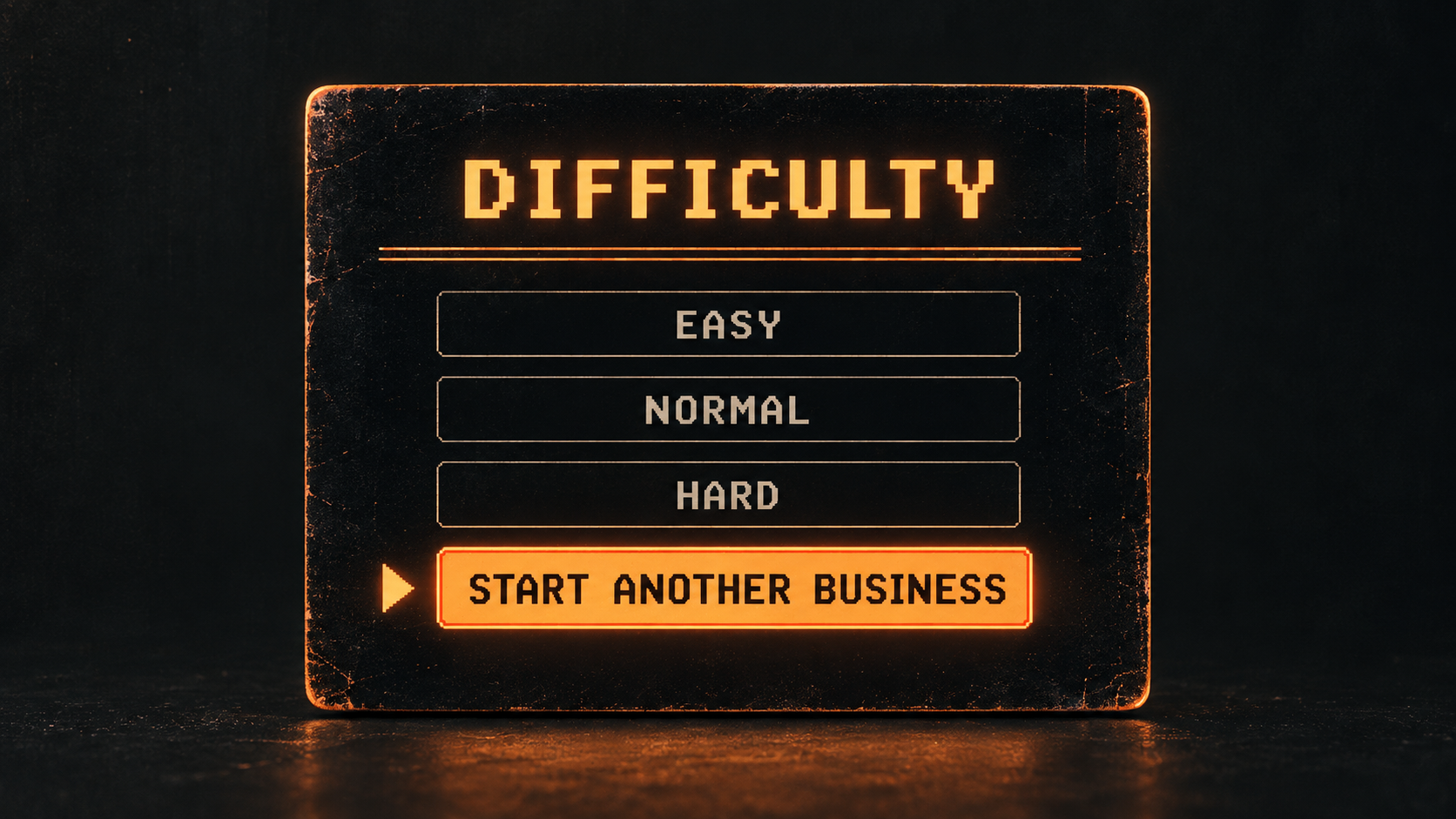
Somewhere right now, a 24-year-old entrepreneur is recording a video about how to build a seven-figure business using nothing but artificial intelligence, a laptop, and the kind of confidence that can only come from never having personally guaranteed a commercial lease.
He's sitting beside a swimming pool. There's probably a Lamborghini involved. He uses the phrase "financial freedom" eleven times.
Meanwhile, somewhere else, a business owner is sitting in a parking lot outside a bank, trying to understand why the financing that was absolutely, positively going to close last Tuesday now requires three additional signatures, an updated appraisal, and possibly a blood sample.
Both are entrepreneurs.
But only one of them is getting the full experience today.
I've spent a good portion of my adult life building businesses, helping other people build businesses, and occasionally wondering why any reasonably intelligent person would voluntarily do this to themselves.
And I've come to believe something that sounds suspiciously like motivational-poster material, although I promise I'm going somewhere with it.
The hard is what makes it great.
Jimmy Dugan Was Right
In A League of Their Own, there's a scene where Dottie Hinson tells Jimmy Dugan she's leaving baseball because it just got too hard.
Jimmy's response is one of my favorite lines in any movie:
"It's supposed to be hard. If it wasn't hard, everyone would do it. The hard is what makes it great."
I love that line because it captures something we don't talk about enough.
We tend to treat difficulty as an unfortunate obstacle standing between us and the thing we want. Something to eliminate, automate, outsource, or otherwise avoid.
And sometimes that's exactly what we should do. I'm not suggesting anyone needs to make their accounting software more difficult just to experience personal growth.
But when we're pursuing something meaningful, difficulty isn't necessarily evidence that we're doing something wrong.
Sometimes it's an essential part of what makes the pursuit worthwhile.
John F. Kennedy understood this when he challenged the country to go to the moon. In his 1962 speech at Rice University, he explained that America had chosen that goal "not because they are easy, but because they are hard."
He wasn't arguing that difficulty alone made the mission worthwhile. There were enormous scientific, technological, and geopolitical reasons to attempt it.
But he understood that choosing an ambitious challenge could summon capabilities we didn't yet possess.
We would have to become better to accomplish it.
There's a reason businesses talk about BHAGs, or Big Hairy Audacious Goals. The idea is to set an objective so ambitious that you can't simply accomplish it by continuing to do what you've always done. You have to stretch, learn, invent, and occasionally question your own sanity.
You don't necessarily know how you're going to get there when you begin.
You just believe it's possible.
And that, to me, is where things get interesting.
My Kids Understand Something About This That Adults Occasionally Forget
I've watched this play out with my children.
When they're playing sports, they don't always want to compete against people they're guaranteed to beat. They want to play in the higher leagues, against better athletes, where they'll be challenged.
Why?
Because they know they'll improve faster.
They'll lose games they could have won in a lower league. They'll encounter players who are stronger, quicker, and more skilled. They'll make mistakes they didn't even know they were capable of making.
But they'll also become better athletes.
And when they finally win at that level, the victory means something different.
The same thing happens with video games.
Give my kids a new game with a difficulty slider, and they're not particularly interested in spending the next forty hours defeating enemies with the strategic sophistication of a household appliance.
They'll start moving that slider up.
And up.
Sometimes to levels that seem designed by developers who genuinely dislike children.
They'll lose repeatedly. They'll yell at the screen. They'll insist the game is cheating, which is a particularly impressive accusation to level against software that is doing precisely what it was programmed to do.
Then they'll try again.
And when they finally beat that level?
The celebration is entirely disproportionate to the fact that they've successfully manipulated a fictional character through a fictional environment to defeat a fictional monster.
But I understand it.
The satisfaction isn't just in winning.
It's in knowing what it took to win.
And there's a wonderful irony here: We voluntarily seek difficult challenges in games and sports, then spend much of our adult lives wondering why the things we care most about aren't easier.
Entrepreneurship Is Mostly Things Nobody Put in the Brochure
The romanticized version of entrepreneurship involves a brilliant idea, a few late nights, an inspiring team, and eventually somebody handing you an oversized check.
The actual version involves considerably more zoning meetings.
You buy a building with a clear vision for what it could become. You hire architects, develop plans, line up financing, and begin imagining the future.
Then you meet the zoning committee.
Not for a few weeks.
For years.
You become intimately familiar with municipal ordinances written during an era when people were apparently very concerned about the placement of windows.
You attend public hearings. You revise drawings. You hire attorneys. You explain your intentions to people who seem personally offended by the concept of change.
And just when you think you're making progress, someone discovers a regulation nobody mentioned during the previous eighteen months.
Congratulations. You're an entrepreneur.
Or consider financing.
You've done the work. The numbers make sense. The lender is enthusiastic. Everyone agrees it's a great opportunity.
The bank just needs another week.
Which becomes another two weeks.
Which becomes another month.
Meanwhile, your contractors, employees, vendors, and landlord have demonstrated an astonishing lack of interest in waiting for your bank.
They would all like to be paid tomorrow.
You explain the situation to your lender, who assures you that the process is moving along nicely.
Apparently, "moving along nicely" is a banking term meaning absolutely nothing is happening.
And then there are the surprises nobody could have reasonably predicted.
A key employee has a serious health issue. A founder gets sick. A supplier disappears. A partner decides they want something entirely different from what they wanted six months ago.
Or a geopolitical event halfway around the world changes your costs overnight.
Tariffs appear. Supply chains collapse. Markets shift. Regulations change.
The business plan you've spent six months developing becomes an interesting historical document.
It's as though someone walked into your office, erased the entire chalkboard, handed you a different-colored piece of chalk, and said, "Okay, now what?"
And that's before we get to the ordinary challenges: customers who don't pay, products that don't work, employees who leave, competitors who emerge, and the occasional realization that your brilliant idea wasn't quite as brilliant as you originally believed.
There are moments when quitting doesn't just seem reasonable.
It seems like the only intellectually defensible decision available.
Which raises an important question.
Why do we keep doing this?
Perseverance Isn't a Superpower. It's the Cover Charge.
We love celebrating entrepreneurial perseverance.
Every successful founder eventually tells a story about the moment they almost quit.
It's practically a requirement. If you haven't considered abandoning your business at least once, I'm not sure you're allowed to speak at a startup conference.
But I don't think perseverance is some extraordinary competitive advantage reserved for a handful of unusually determined people.
I think it's the entry fee.
If you're going to build something meaningful, you have to accept that there will be setbacks you can't anticipate, obstacles you can't control, and problems that don't respond to your preferred timeline.
Being intelligent helps.
Having a good strategy helps.
Money certainly helps, although I've noticed it has a remarkable ability to disappear precisely when you need it most.
But none of those things eliminates the hard parts.
And getting through those parts requires something beyond intelligence or resources.
It requires a belief that the thing you're pursuing is worth continuing to pursue, even when the evidence temporarily suggests otherwise.
It requires hope.
Not the naive belief that everything will work out. Most entrepreneurs have accumulated enough evidence to know better.
But the stubborn, occasionally unreasonable belief that something better is possible, and that our efforts might help bring it into existence.
Every business begins with some version of that hope. A product that could be better. A problem that could be solved. A community that could be transformed. An idea that deserves a chance to become real.
Barack Obama titled his book The Audacity of Hope, and I've always liked the pairing of those words.
Because there's something inherently audacious about hope.
It asks us to believe in possibilities that don't yet exist, often when the circumstances in front of us offer very little encouragement.
And entrepreneurs do that almost compulsively.
We believe customers will buy something they've never seen. That talented people will leave secure jobs to join us. That investors will take a chance. That markets will emerge. That we'll somehow solve problems we don't even know exist yet.
It's an objectively ridiculous collection of assumptions.
And yet, without people willing to make them, very little new would ever get built.
Hope isn't the belief that everything will work out.
It's the belief that something is worth attempting even though it might not.
And sometimes, that belief is what gets us out of bed for another round.
In Rocky Balboa, Rocky gives his son a speech about how hard life can hit. His point isn't that you need to hit back harder than everyone else.
It's that life will knock you down, sometimes repeatedly, and what matters is whether you can keep moving forward.
I've always loved that scene.
Not because I think entrepreneurs should aspire to spend their lives getting punched in the face. That's a terrible business model, unless you're actually a boxer.
But because there's something powerful about believing in yourself when circumstances are giving you very little reason to.
And I don't mean the performative confidence of someone announcing that failure isn't an option.
Failure is absolutely an option.
I've met it. We've exchanged business cards.
I mean the quieter belief that you can encounter something difficult, maybe even devastating, and still trust yourself to figure out what comes next.
Not necessarily to save the original plan.
Sometimes that plan is gone.
But to find a way forward.
The Hard Changes You
Here's what I think is most interesting about all of this.
When we pursue something difficult, we tend to focus on what we'll have when we're finished.
The company. The building. The product. The championship. The accomplishment.
But the process itself changes us.
You develop judgment you didn't have before. You learn to recognize patterns, manage uncertainty, have uncomfortable conversations, and make decisions when none of the options is especially attractive.
You learn who you can count on.
You discover that some people who seemed indispensable weren't, and others you barely noticed become the people who help carry you through.
You learn which problems deserve your attention and which ones will happily consume every waking hour if you allow them to.
You become more resourceful. Sometimes more patient. Occasionally less patient, particularly with banks.
And perhaps most importantly, you develop a different relationship with your own capabilities.
You discover you can do things you previously believed were beyond you.
That's difficult to appreciate before you've experienced it.
You can read books about leadership, listen to podcasts about resilience, and ask AI to explain how to navigate uncertainty.
All useful.
But none of those things can give you the experience of actually having done it.
You can't download the judgment that comes from watching a plan fall apart and having to build a new one while everyone around you is looking for answers.
You have to live that.
And once you have, you're different.
My kids don't want to play in more competitive leagues simply because winning will look better on a trophy.
They want to become the kind of players who can compete there.
I think entrepreneurs are often pursuing something similar, whether we recognize it or not.
We're not just trying to build something better.
We're becoming people capable of building something better.
But There's a Difference Between Perseverance and Refusing to Admit Defeat
Now, here's where I need to complicate my own argument.
Because if I've learned anything from decades of building businesses, it's that not every difficult thing is worth continuing.
Some businesses are hard because they're attempting something ambitious.
Others are hard because the underlying business doesn't work.
And the universe does not provide a convenient little label explaining which is which.
Sometimes the zoning fight is worth another two years.
Sometimes the lender who's been promising financing for nine months is never going to close.
Sometimes the market really isn't there.
Sometimes the partners aren't right.
Sometimes you've spent so long fighting to make something succeed that you've forgotten to ask whether success would even look like something you still want.
This is where entrepreneurial perseverance can become dangerous.
Because the same determination that helps you overcome extraordinary obstacles can also keep you attached to something long after you should have let it go.
And if your identity is wrapped up in being the person who doesn't quit, walking away can feel like a personal failure rather than a rational decision.
I've been thinking about this a lot lately.
At a recent retreat, I was asked to complete a simple statement:
"I give myself permission to..."
One of my answers was to decide when it's time to let go, and be okay with it.
That second part matters.
Because knowing when to quit is difficult enough.
Being at peace with the decision afterward might be harder.
I don't have a perfect formula for distinguishing worthwhile difficulty from pointless suffering.
I wish I did. I'd sell it as a subscription service and finally become one of those entrepreneurs recording videos beside a swimming pool.
But I suspect wisdom involves learning to separate our commitment to a meaningful goal from our attachment to a particular path.
You can believe deeply in what you're trying to accomplish and still acknowledge that the way you've been trying to accomplish it no longer works.
You can change strategies.
You can change partners.
You can change the business.
And sometimes, you can stop altogether.
That doesn't erase the value of what you attempted or what you learned.
It just means you're making a different decision with the information you have now.
Because there's a difference between hope and an inability to let go.
Hope gives us a reason to keep trying. But it shouldn't prevent us from recognizing when the thing we're trying to save has changed, or when the cost has become greater than what we originally hoped to accomplish.
Learning that distinction may be one of the hardest lessons entrepreneurship has to teach us.
The Hard Is What Makes It Great
I still believe Jimmy Dugan was right.
The hard is what makes it great.
Not because suffering is noble. Not because every struggle ends in triumph. And certainly not because there's some cosmic guarantee that if you work hard enough, everything will turn out the way you imagined.
There isn't.
But there's something extraordinary about looking at a challenge, knowing full well that it might break your heart, empty your bank account, test your relationships, and occasionally make you question your own intelligence, and deciding to try anyway.
Think about how irrational that is.
Nobody makes you start a business. Nobody makes you take an idea that exists only in your imagination and attempt to turn it into something real. Nobody forces you to risk your time, your money, your reputation, and your comfortable Saturday afternoons pursuing something that might never work.
And yet, people do it every day.
They walk into banks. They face zoning committees. They pitch skeptical investors. They hire their first employee. They sign leases. They build prototypes. They get rejected, disappointed, blindsided, and occasionally punched squarely in the face by circumstances nobody saw coming.
And then, somehow, they get up the next morning and try again.
Not because they're guaranteed to win.
Not because they're incapable of quitting.
But because they believe something is worth the effort.
And underneath that belief is hope.
Not the kind that promises a happy ending. The kind that makes us willing to begin without one.
Maybe that's the part of entrepreneurship I admire most.
Not the exits. Not the valuations. Not the magazine covers or the carefully curated success stories.
It's the audacity of the attempt.
The willingness to look at something that doesn't exist and believe, perhaps against all available evidence, that you might be the person who can bring it into the world.
Of course, experience eventually teaches us that not every battle is worth fighting. Not every business deserves another year. Not every dream needs to become a lifelong obligation.
And perhaps that's the wisdom we earn along the way.
The greatest skill isn't simply learning to endure difficulty. It's learning which difficulties deserve us.
But when you find one that does?
When you find something that matters enough to risk failing, something that calls on everything you've learned and still asks you to become more?
I hope you have the courage to go after it.
Move the difficulty slider all the way up.
Take the swing. Build the thing. Chase the improbable idea.
You might fail spectacularly.
You might discover you're capable of considerably more than you ever imagined.
You might even change the world a little.
And someday, when someone asks why you willingly put yourself through all of that, I hope you can smile, think about everything it took, and give them the only answer that really makes sense.
Because the hard is what makes it great.